

Have you ever shared a PDF resume or tax form and thought all your private data was permanently hidden? The hidden risk is that you may miss some sensitive information to redact, or simple markings can often be removed, exposing your secret.
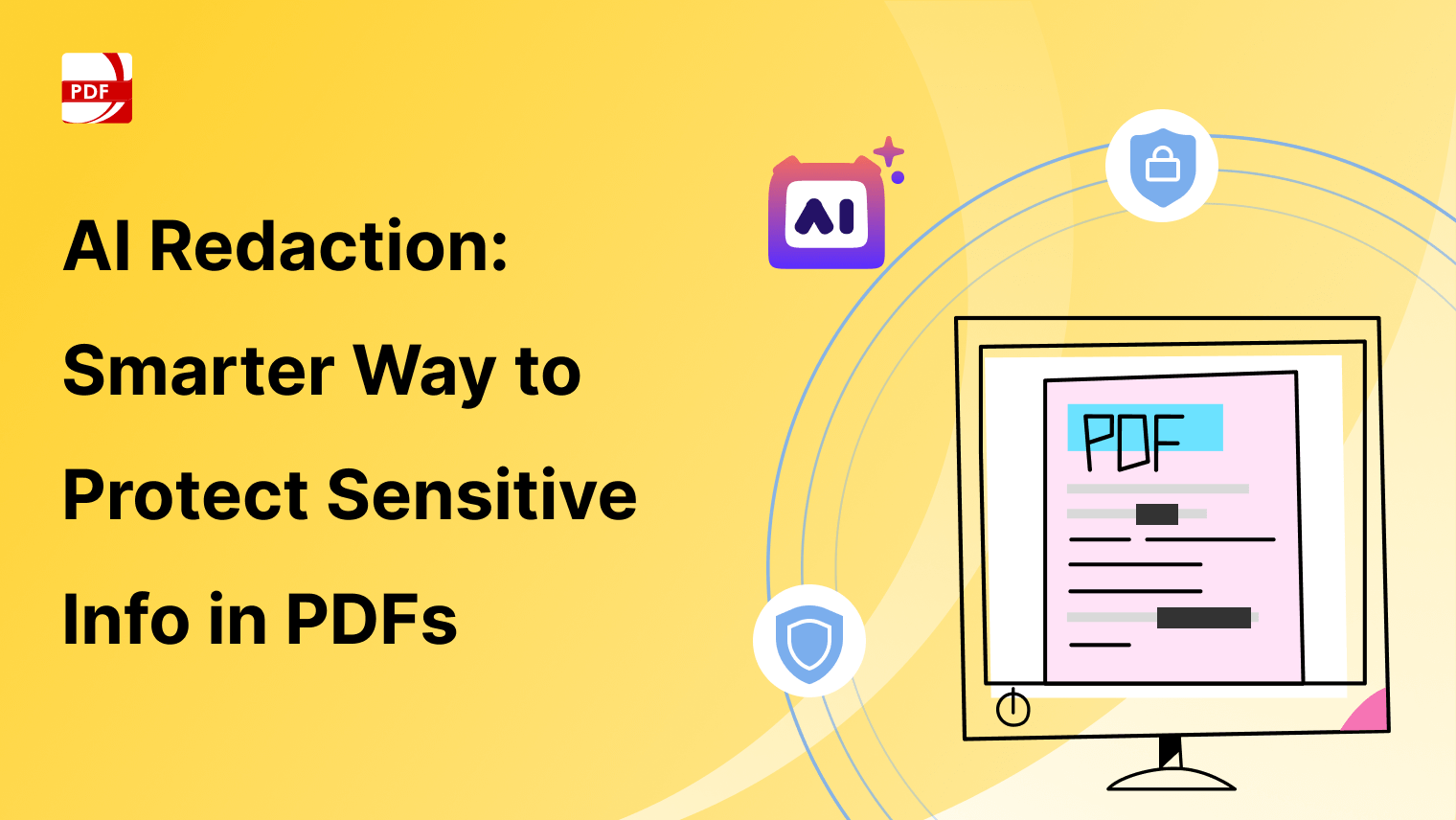
To fully and truly protect privacy, a smarter approach is needed: AI redaction. This technology automatically removes sensitive data, ensuring your documents stay private.
This article will walk you through:
- What AI redaction is and why it’s important for protecting sensitive data.
- Which types of information should be redacted.
- How AI redaction works with the combination of OCR, Pattern Recognition, and NLP.
- The future of redaction and how tool like PDF Reader Pro is bringing AI-powered document protection into workflows.
Let‘s dive in!
What Is AI Redaction and Why It Matters
AI redaction utilizes artificial intelligence to detect and protect sensitive data in digital files, especially PDF files. It combines OCR, Pattern Recognition, and Natural Language Processing (NLP) technologies. Transforming manual methods into AI redaction can not only eliminate common file risks, but also make privacy compliance easier.
What Information Should Be Redacted in Documents
Wondering what information should be redacted? Actually, not all data is sensitive, but certain categories are widely recognized as requiring redaction:
1、Personally Identifiable Information (PII)
According to the definition of the National Institute of Standards and Technology (NIST), name, address, passport number, or social security number are all considered PII. Under Rule 5.2 of the Federal Rules of Civil Procedure (FRCP), these identifiers must be concealed in court documents. If personal information is not properly protected, it may lead to identity theft if leaked.
2、Financial and Contact Details
The Federal Trade Commission (FTC) report states that financial identity theft remains one of the most frequently complained cases by consumers. Therefore, it is necessary to redact these financial and contact details such as credit card numbers, bank account information, tax identification numbers, email addresses and phone numbers.
3、Sensitive Work or Study Data
Draft contracts, student records, and research notes may disclose intellectual property or privileged information. Especially in e-discovery, courts usually require parties to carefully consider the content that needs to be deleted from legal documents, especially those involving trade secrets.
With AI redaction, this important information can be quickly and accurately identified and redacted, and you no longer have to worry about missing out on manual redaction.
How AI Redaction Works
Traditional redaction relies on manual processing, while AI redaction uses a combination of optical recognition and language analysis to extract sensitive data in PDFs. This makes the document processing faster and the information more accurate than manual redaction.
Step 1: Use OCR to Recognize Text
- OCR converts non-selectable text into machine-readable characters, allowing the system to "view" and process previously invisible information, such as scanning social numbers on forms.
Step 2: Use AI to Understand and Process Text
- Natural Language Processing (NLP) can understand context and identify entities such as names, dates, or specific terms.
- Pattern Recognition can extract structured data formats, such as credit card numbers or phone numbers, regardless of how they are presented.
By combining these two technologies, AI redaction ensures comprehensive protection of sensitive data. This integration method can meet the compliance with laws and regulations and is widely recognized.
The Future of Redaction and Intelligent Document Processing
With the expansion of digital communication, the need to protect sensitive information has become crucial. A single failure properly leads to identity theft, fraud, or legal consequences. In this context, AI-powered redaction is evolving from a convenient means to a global standard for document security.
1、Growing Trend of Privacy Protection
Regulations such as the General Data Protection Regulation (GDPR) in Europe and the California Consumer Privacy Act (CCPA) in the U.S. require organizations to protect personal information, otherwise they will face severe penalties.
Beyond corporate compliance, individuals are increasingly aware of what information should be redacted before sharing documents online. AI redaction will become the new standard. It will no longer be just an optional feature, but a core component of smarter, more secure document management for individuals and organizations.
2、PDF Reader Pro and Intelligent PDF Processing
To advance intelligent PDF workflows and enable users to manage documents more intelligently and securely, PDF Reader Pro is adding AI redaction feature so that it can secure sensitive data while keeping processes efficient.
This progress is reinforced by the proven success of our companion solution, ComIDP, which already processes unstructured data at scale—automatically extracting, classifying, and securing information.
AI redaction will soon become an essential feature for anyone seeking security and ease of use in PDF management. PDF Reader Pro is committed to leading this shift toward smarter and safer document processing.
Conclusion
AI redaction makes privacy protection effortless, replacing slow manual edits with automatic, reliable protection. With PDF Reader Pro, you’ll soon take advantage of this power in your workflow.
Try it out with a 7-day free trial and stay ahead in secure, smart document handling!
 Free Download
  Free Download



 Support Chat
  PDF Reader Pro